Franciszka Themerson
Artist - Illustrator - Avant-Garde Pioneer
Franciszka Themerson (1907–1988) was a Polish-born artist, illustrator, designer and filmmaker, and a leading figure of the European avant-garde. Known for her playful, surreal and inventive visual language, she worked across drawing, painting, graphic design and film. In 1948, she and her husband Stefan founded the pioneering Gaberbocchus Press in London, producing experimental books that brought together art, literature and design.
About Franciszka Themerson…
Franciszka Themerson, daughter of the painter Jakub Weinles, was born in Warsaw, 1907, and graduated from the Warsaw Academy in 1931. The same year, she married the writer and experimental photographer, Stefan Themerson, and during the 1930s they became kingpins in a small but vital Polish film-making avant-garde. Their films were financed in part by a series of inventive books for children (his words, her drawings). Moving to Paris in 1938, they were overtaken by the outbreak of war, separated, and finally reunited in 1942 in London, where in 1948 they founded their highly original Gaberbocchus Press. She designed most of the 70 books they published and illustrated many, most memorably Jarry’s Ubu Roi (1951). She also designed marionette productions of UBU in Stockholm and Copenhagen (1960s/70s).
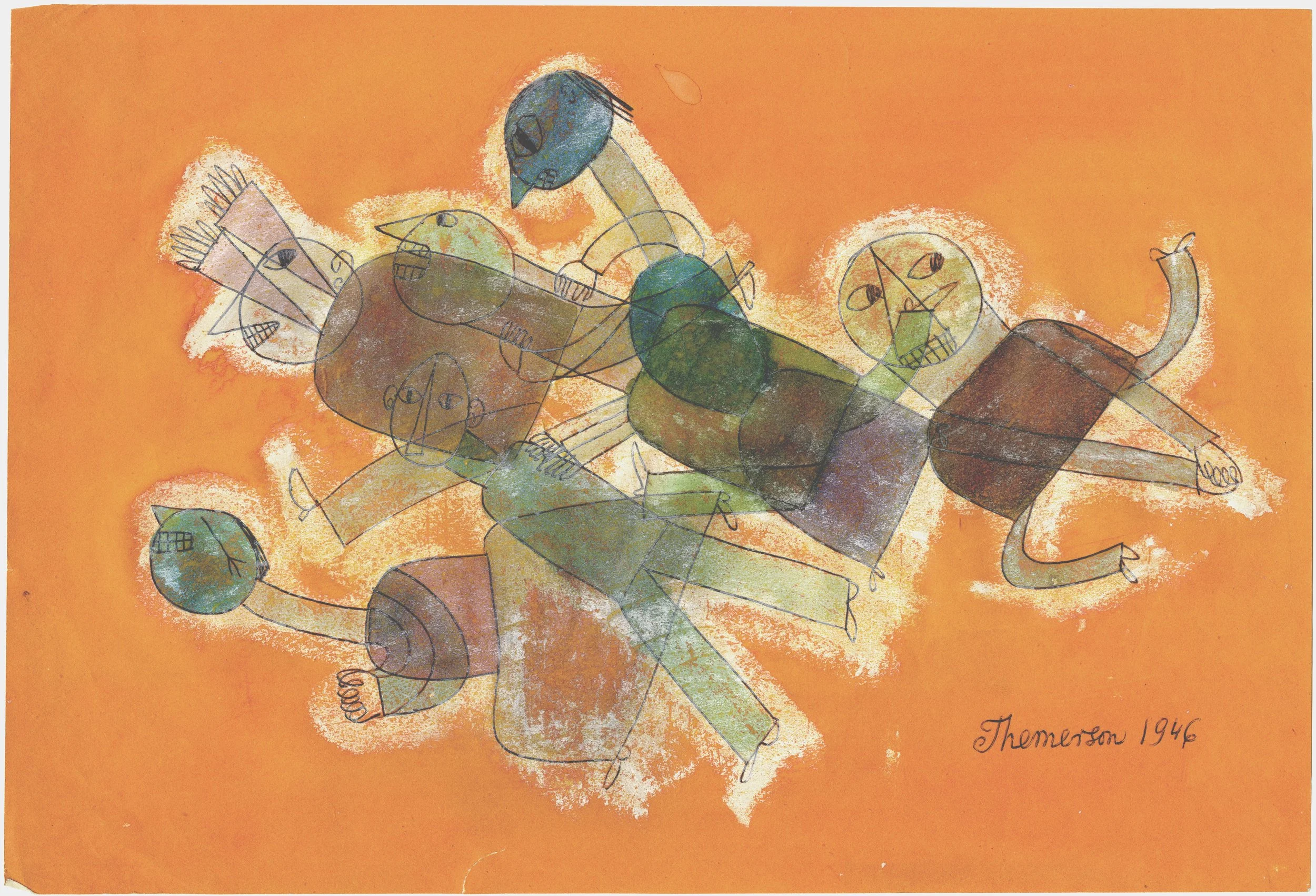
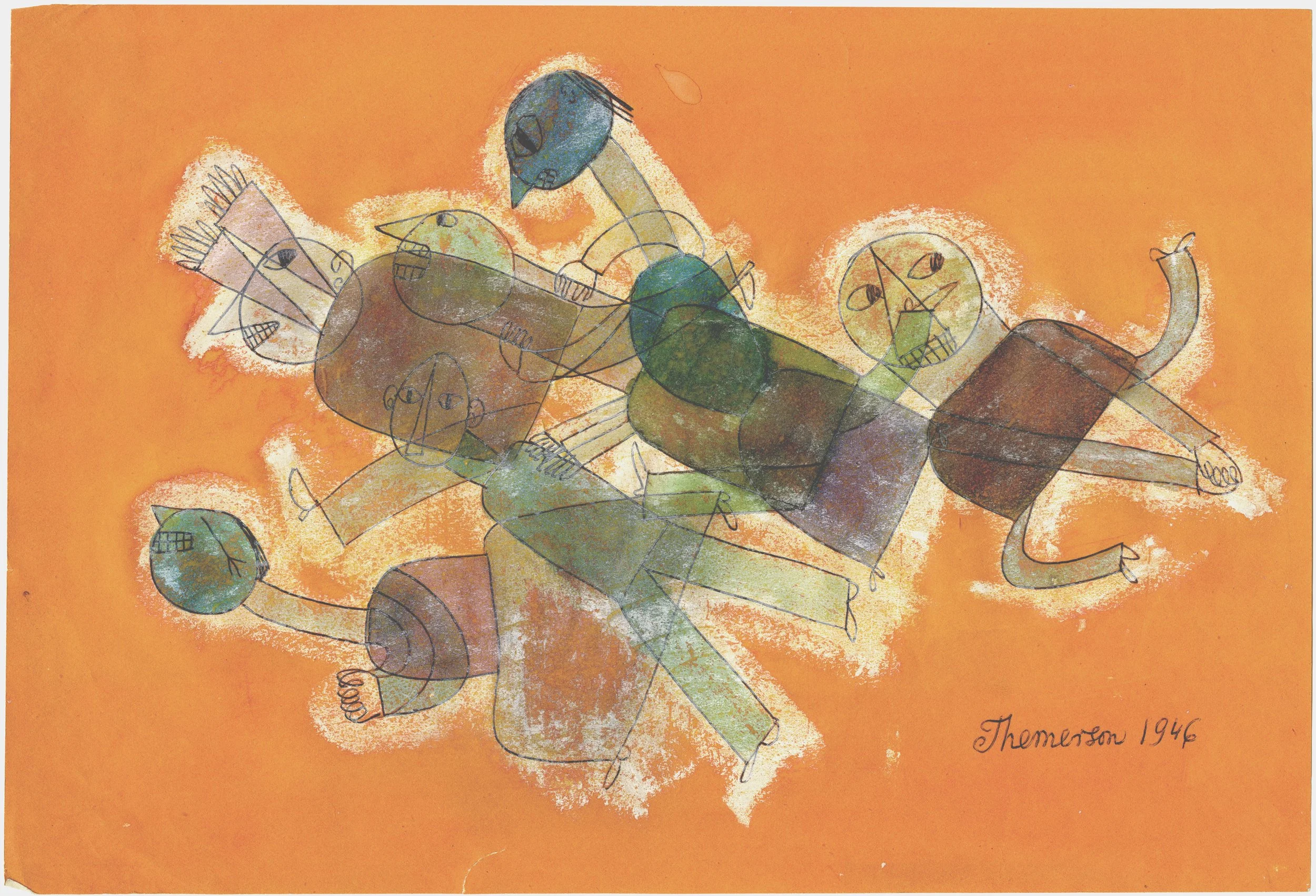
Alongside this busy world, Franciszka’s independent career as an artist was forged. A natural draughtsman, she steadily accumulated ways of painting that enabled her to draw with and into the paint, using knives, sticks, fingers, anything but the right end of a brush, and always with an easy dexterity. Line is at a higher premium than colour generally, and towards the end she even abandoned the light glazes of her mature art to work in luminous whites and off-whites. Her subject from the outset was the human condition, and the mood of her imagery ranged from the comic (but never caricatural) to the tragic (but never expressionistic) with techniques in which the subject and its medium walked hand-in-hand, embedded in each other. In a typical painting or drawing, faces and figures grow out of and dissolve into each other in what seems an endlessly fertile natural cycle. The wit and range of her titles exemplifies the breadth of her cultural reference. She died in London in 1988.
Nick Wadley
Art & Practice…
Franciszka Themerson’s practice resists the boundaries of medium. Painting, drawing, illustration, book design, film and theatre were not discrete activities within her career, but interconnected forms through which she investigated the figure, movement, language and the unstable relationship between representation and abstraction.
Although her work became widely associated with the experimental culture she developed with Stefan Themerson, Franciszka’s own practice was fundamentally rooted in painting. She trained at the Warsaw Academy of Fine Arts, graduating in 1931 with the highest distinction, and throughout her career continued to regard drawing and painting as central to her artistic enquiry. As the critic and curator Jasia Reichardt later observed, “essentially — or originally — she was a painter for whom line became an autograph language.”
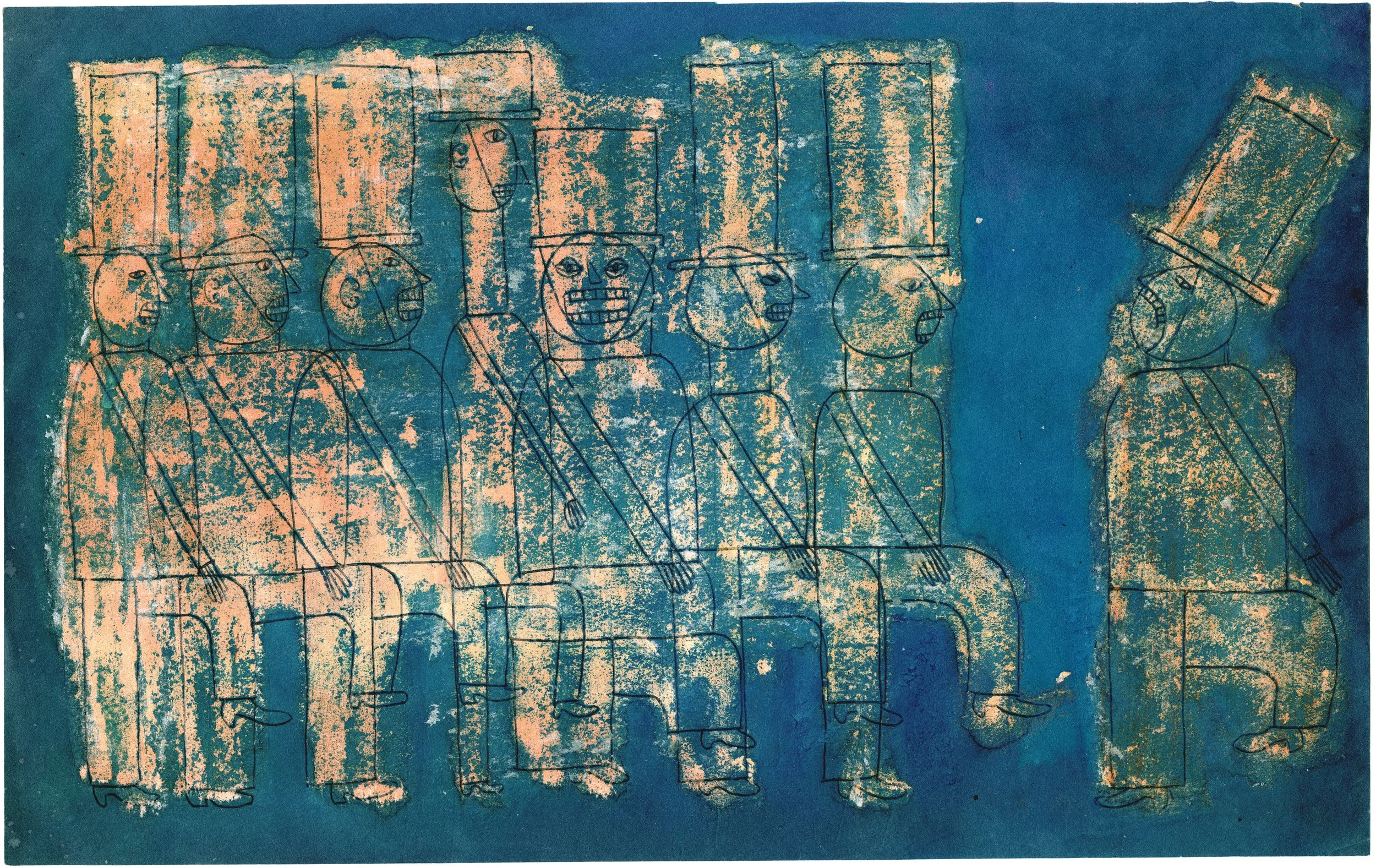
Line is indeed the organising principle of Themerson’s work. It describes, constructs and destabilises the human figure simultaneously. Her early drawings developed a cast of eccentric, often bowler-hatted figures: comic and apparently self-contained characters whose gestures and postures gradually became less caricatural and more psychologically charged. Themerson later described the transformation of these figures as a movement away from the comic gentleman towards the vulnerable human being — towards figures capable of fear, suffering and uncertainty.
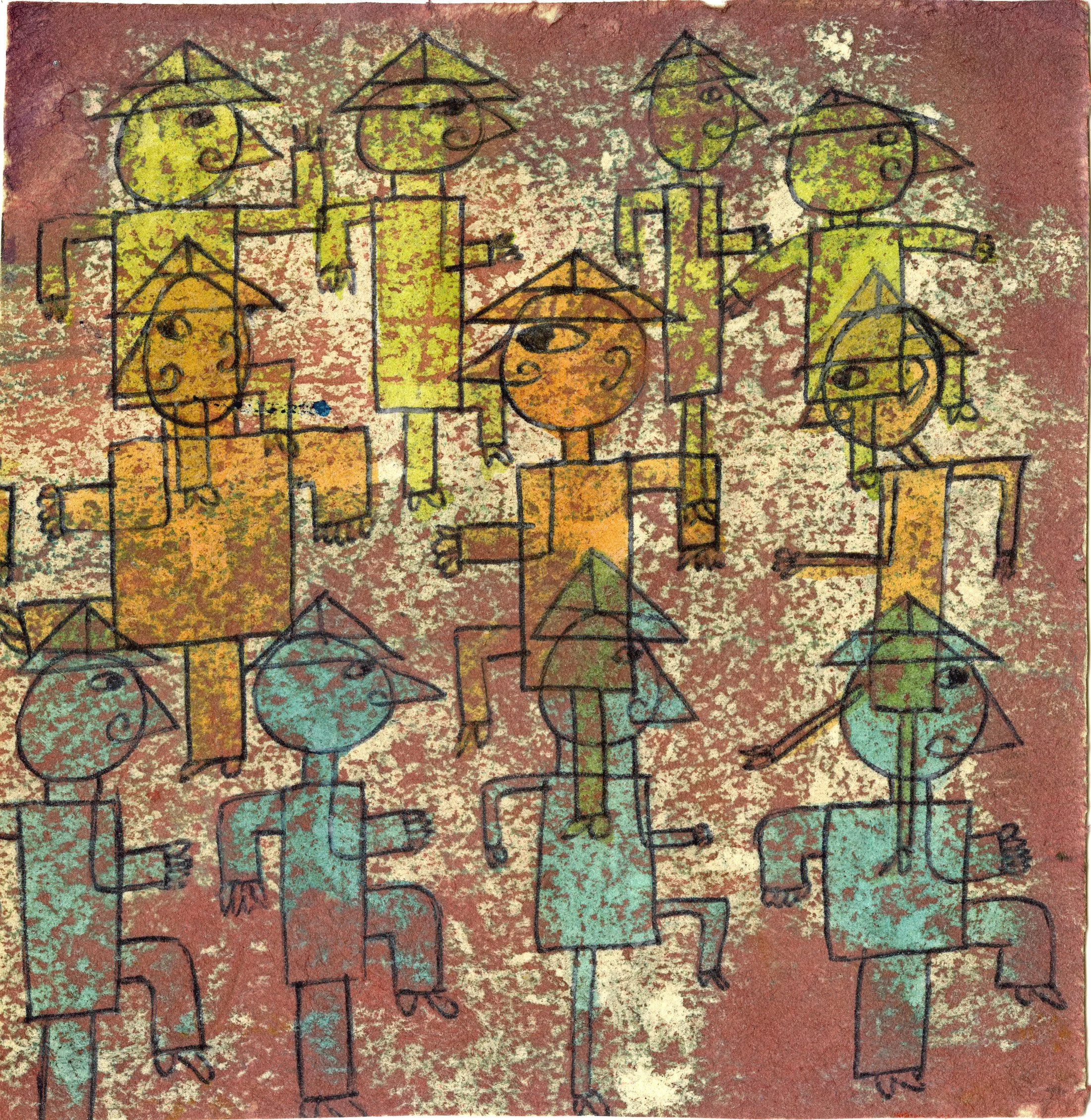
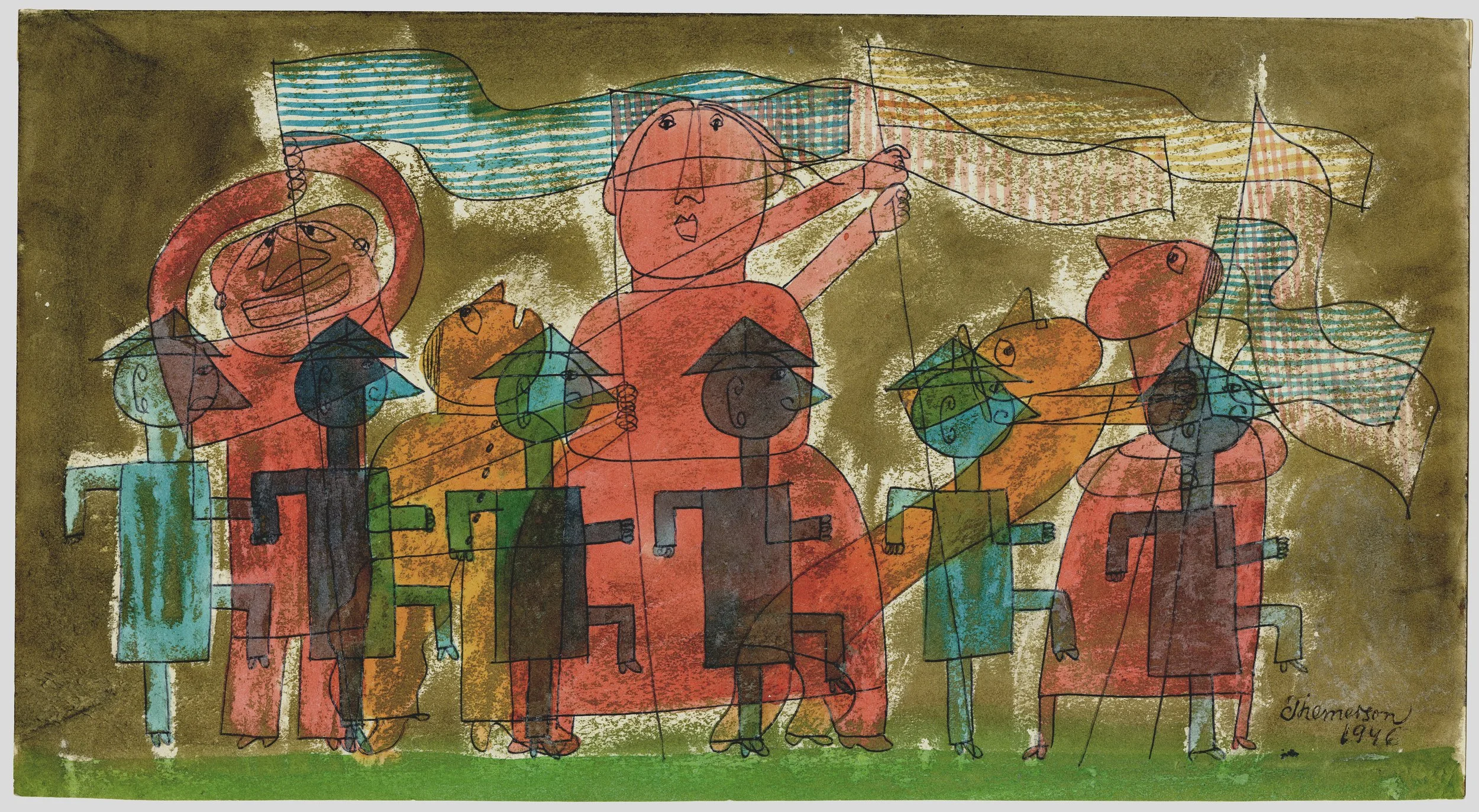
It was this intersection of the figurative and the abstract that led Themerson to describe her mature painting as “bi-abstraction.” The term is revealing. Rather than abandoning figuration for abstraction, she allowed the two conditions to coexist: bodies emerge from fields of marks, lines become spatial structures, and recognisable forms hover between depiction and dissolution. The resulting paintings possess an unusual tension between apparent simplicity and considerable formal complexity.
This same fluidity characterises her drawings. Improvisation, satire and an acute sensitivity to the gestures of everyday life are brought together through a remarkably economical line. Her subjects range across the human world — its pleasures, anxieties, absurdities and contradictions — while the act of drawing itself remains visible.
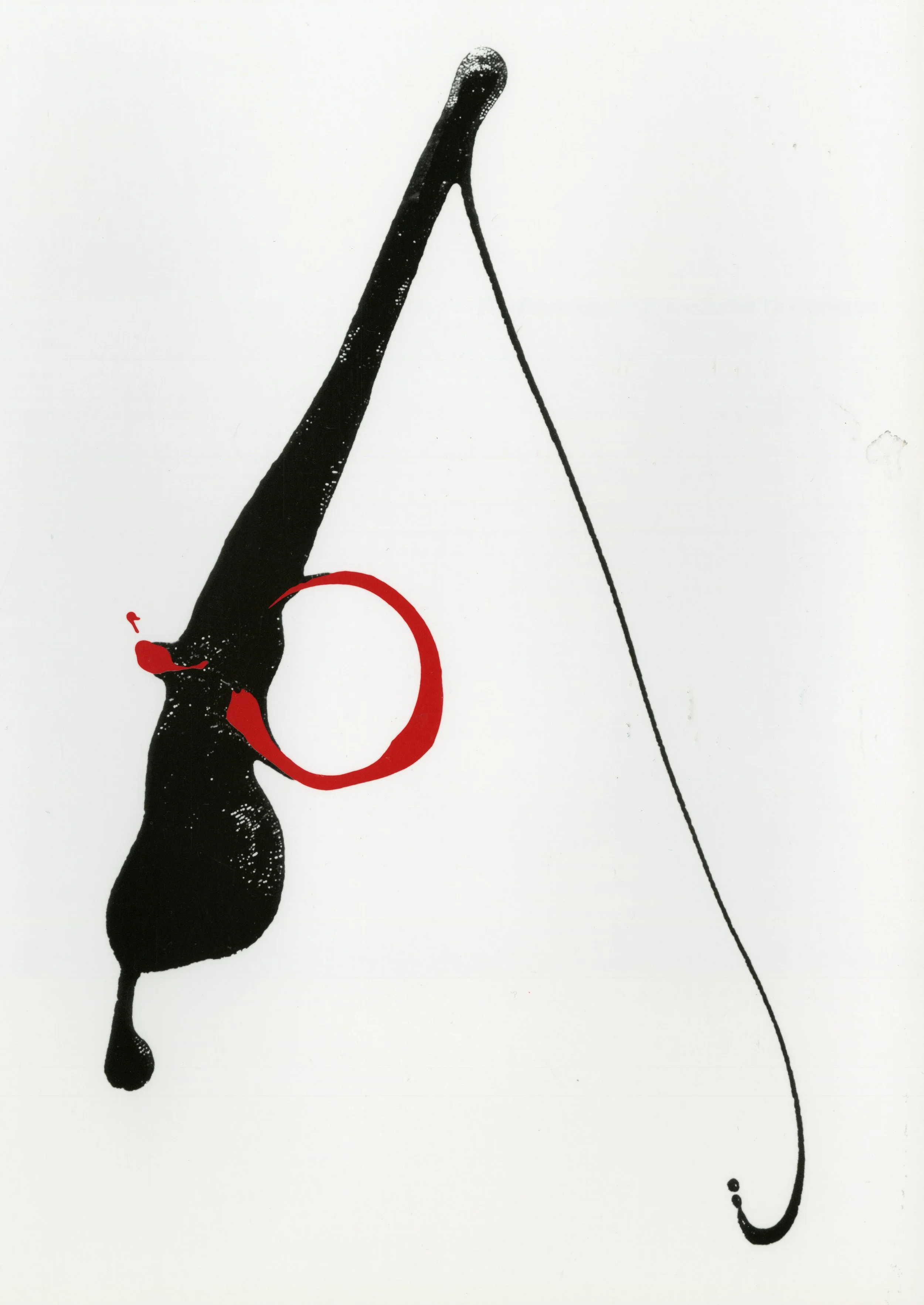
Themerson’s engagement with Alfred Jarry’s Ubu Roi provides perhaps the clearest demonstration of the permeability of her practice. For the first English edition, published by the Themersons’ Gaberbocchus Press in 1951, she produced 204 drawings directly onto the lithographic plates carrying Barbara Wright’s handwritten translation. The drawings do not simply illustrate the text; image and typography occupy the same visual field, creating a work in which reading and looking become inseparable.
Her relationship with Ubu continued for decades, moving from book illustration into theatre design and finally into an extensive sequence of drawings. For Michael Meschke’s 1964 production at Stockholm’s Marionetteatern, Themerson designed masks, costumes and sets; between 1967 and 1970 she returned to the subject in a sequence of ninety large drawings.
This movement between disciplines is central to understanding Themerson. The book becomes a space for drawing; drawing becomes theatre; theatre becomes an investigation of the body; and the body, in her paintings, becomes a means of approaching abstraction.
Rather than illustrating an idea, Themerson’s line thinks its way towards one. Her work occupies the space between humour and unease, figuration and abstraction, order and improvisation — a space in which the act of looking remains active, uncertain and continually open.
Gallery