Dominic Boreham
Pioneer of Computer Art and Kinetic & Light Art
Dominic Boreham’s visual art spans across a wide range of genres and mediums. He is acclaimed internationally for his pioneering use of computers, kinetics and light for making visual art in the 1970s and 80s. The innovative and iconic artworks that were made using novel technologies intersected with his knowledge of visual perception, psychology, philosophy, quantum physics and Buddhism.

About Dominic Boreham…
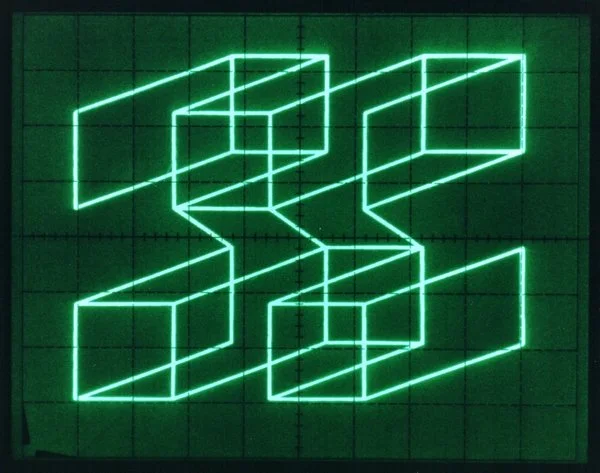
Dominic Boreham (1944–2022) was a British artist and pioneer of computer-assisted and kinetic art. Born in Woodford, Essex, he studied at Wimbledon School of Art and the Slade School of Art before undertaking doctoral research at the Royal College of Art. In the late 1970s, he began using computers to generate drawings with a flat-bed plotter, producing the pioneering STOS and Interference Matrix series.
Boreham’s practice developed from an early interest in painting and graphics into experiments with light, optics, electronics, computer programming and visual perception. From 1979 to 1982 he edited PAGE, the journal of the Computer Arts Society, becoming an important figure within the emerging international field of computer art. His work was subsequently exhibited widely, including at the Victoria and Albert Museum, Centre Pompidou and Sainsbury Centre.
In the 1980s Boreham returned increasingly to painting and drawing, developing a highly individual abstract language informed by his investigations into perception, psychology, philosophy and Buddhist thought. He later described this work as Transactional Non-Objective Art and Transpsyche Art. After moving to Burgundy in 1991, he continued to paint and draw until his death in 2022.
Art & Practice…
Dominic Boreham’s practice is rooted in an enduring investigation into perception, technology and the nature of visual experience. Moving between painting, drawing, computer-generated imagery, light and kinetic experimentation, he treated art as a means of examining how images are constructed, perceived and understood.
From the late 1970s, Boreham became an important early practitioner of computer-generated art. Working with plotters and programmed systems, he produced drawings in which mathematical structures, repetition and controlled variation generated complex visual fields. His STOS and Interference Matrix works emerged from this period, bringing together technological processes with questions traditionally associated with painting and drawing.
Rather than regarding the computer simply as a new artistic medium, Boreham explored its potential as a system for generating visual thought. The machine became a collaborator in the construction of the image: algorithms established parameters, while variation and chance produced results that could not always be anticipated in advance.
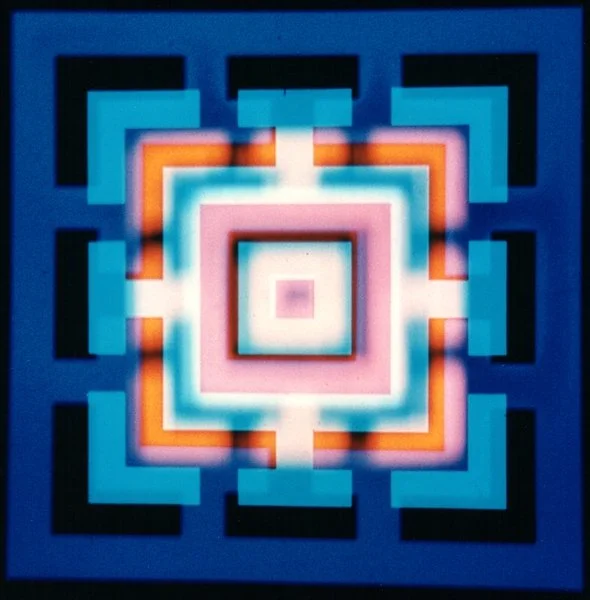
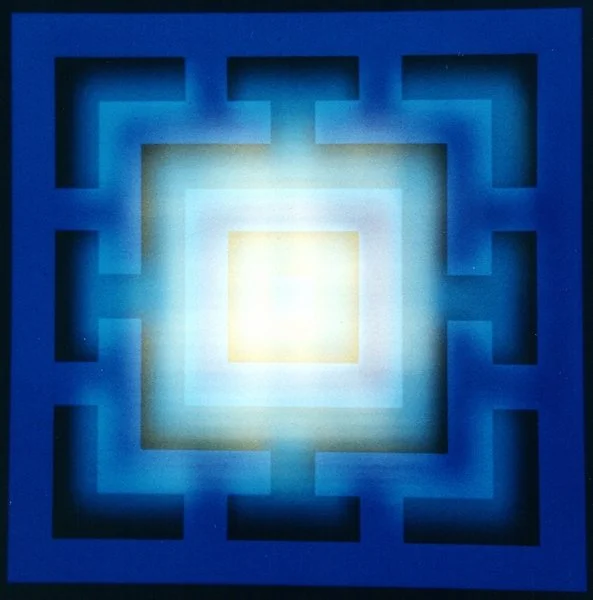
During the 1980s, his practice increasingly returned to painting and drawing, but the conceptual concerns developed through his technological experiments remained. Colour, geometry, optical relationships and the movement of the eye became central to increasingly immersive abstract compositions.
Boreham subsequently developed his ideas through what he termed Transactional Non-Objective Art and Transpsyche Art, reflecting his interest in psychology, philosophy, perception and consciousness. His later paintings are less concerned with depicting an external subject than with creating conditions in which the viewer becomes conscious of the act of looking itself.
Across his career, Boreham maintained a dialogue between technology and intuition, order and chance, mathematics and perception. His work occupies a distinctive position between early computer art and contemporary abstraction, demonstrating that the questions raised by digital technology can ultimately lead back to one of painting’s oldest concerns: how an image acts upon the mind of the person looking at it.
Gallery